
The Cotswolds is full of places that are beautiful to look at. Honey-coloured cottages, medieval churches, old coaching inns and market squares appear around almost every corner.
But there is a big difference between seeing the Cotswolds and understanding what you are seeing.
That is where a privately guided tour with a knowledgeable local guide really comes into its own.
With Cotswolds Travel, John does much more than drive visitors between the region’s best-known villages. He can explain the stories behind the buildings, landscapes and communities you pass through – pointing out details that are easy to overlook and putting them into their historical context.
One particularly good example can be found in Stow-on-the-Wold.
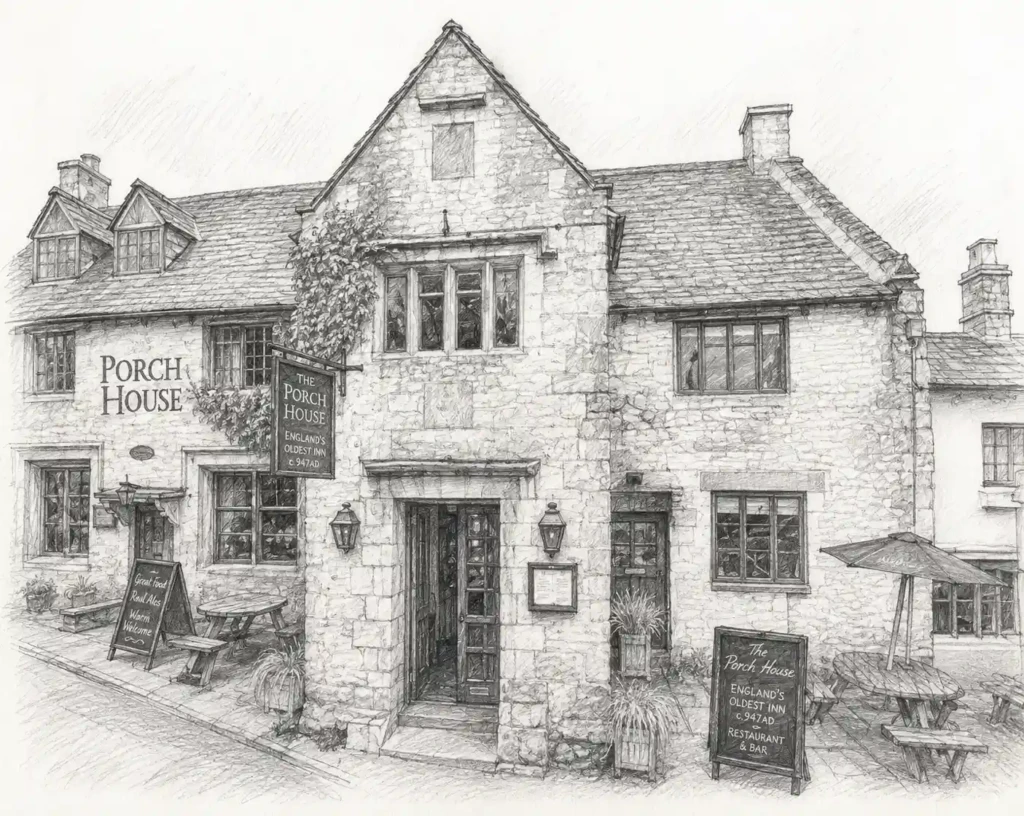
The Porch House: nearly 1,000 years of history?
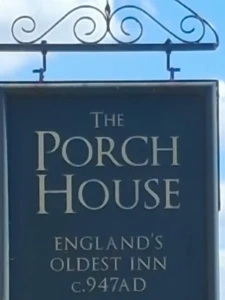 Walk down Digbeth Street in Stow-on-the-Wold and you will come across The Porch House, whose sign makes an extraordinary claim:
“England’s Oldest Inn – c.947 AD.”
The Porch House itself describes the property as England’s oldest inn, and the story traditionally associated with the site dates its origins to AD 947. (The Porch House)
That would mean travellers were stopping here more than a century before William the Conqueror arrived in England and almost 140 years before the Domesday Book was compiled.
It is an irresistible piece of Cotswolds history.
But it is also exactly the kind of story where having a knowledgeable guide adds another dimension.
Claims about Britain’s “oldest pub” or “oldest inn” are notoriously difficult to prove conclusively. Buildings change, businesses move, records disappear and later traditions become intertwined with documented history.
Historic England’s listing for the building – formerly recorded as The Royalist Hotel and Porch House – describes the surviving structure as possibly dating from the 16th century, with substantial remodelling in the early 17th century. It is Grade II* listed and described as a good Jacobean town house. (Historic England)
So what should we make of the famous 947 date?
Perhaps the most interesting answer is not simply whether the claim can be proved, but the story it opens up.
There may have been hospitality on or around the site long before the present building took its current form. What survives today is unquestionably historic, while the tradition surrounding its much earlier origins has become part of Stow’s identity.
It is the distinction between the history you photograph and the history you discuss.
This is where a guided tour becomes different
You could walk past The Porch House, photograph the sign and move on.
Or you could stop and ask:
Why would there have been an inn here?
Who was travelling through Stow?
Why did this relatively small Cotswolds town require so many inns and places of hospitality?
And why did Stow become important in the first place?
The answers begin to reveal how the Cotswolds developed.
Stow sits high on the wold at the meeting point of several ancient routes, including the Fosse Way, the Roman road that crosses the Cotswolds.
Henry I granted Stow the right to hold a weekly market in 1107. During the Middle Ages the town became an important centre for the wool trade, with sheep, fleeces, merchants and travellers converging on its unusually large Market Square. (Stow on the Wold Town Council)
Suddenly the old inns make much more sense.
They were not merely picturesque buildings. They formed part of the commercial infrastructure of a thriving market town.
Look more closely at Stow’s Market Square
Stow is a particularly rewarding place to explore with somebody who knows what to look for.
Its enormous Market Square is itself a clue to the town’s past. It provided the space required for the livestock markets and fairs that helped generate the wealth of medieval Stow.
Then there are the narrow passages leading away from the square, traditionally known as tures. They are believed to have helped funnel sheep into the marketplace from the surrounding pasture.
Without somebody pointing them out, it is remarkably easy to walk straight past them.
The medieval market cross tells another part of the story. Market crosses stood at the heart of commercial life and could provide a symbolic reminder that trading should be conducted honestly. The surviving cross at Stow retains historic elements, although its shaft and head have been restored. (Historic England)
Nearby are the old town stocks.
Within a few minutes’ walk, therefore, you can begin to reconstruct an entire medieval marketplace: sheep arriving through narrow passageways, merchants negotiating transactions, travellers seeking food and accommodation and local justice being administered very publicly.
That is considerably more interesting than simply being told that Stow is “a pretty Cotswolds village”.
Then the story changes completely
Stow also played a dramatic role in the English Civil War.
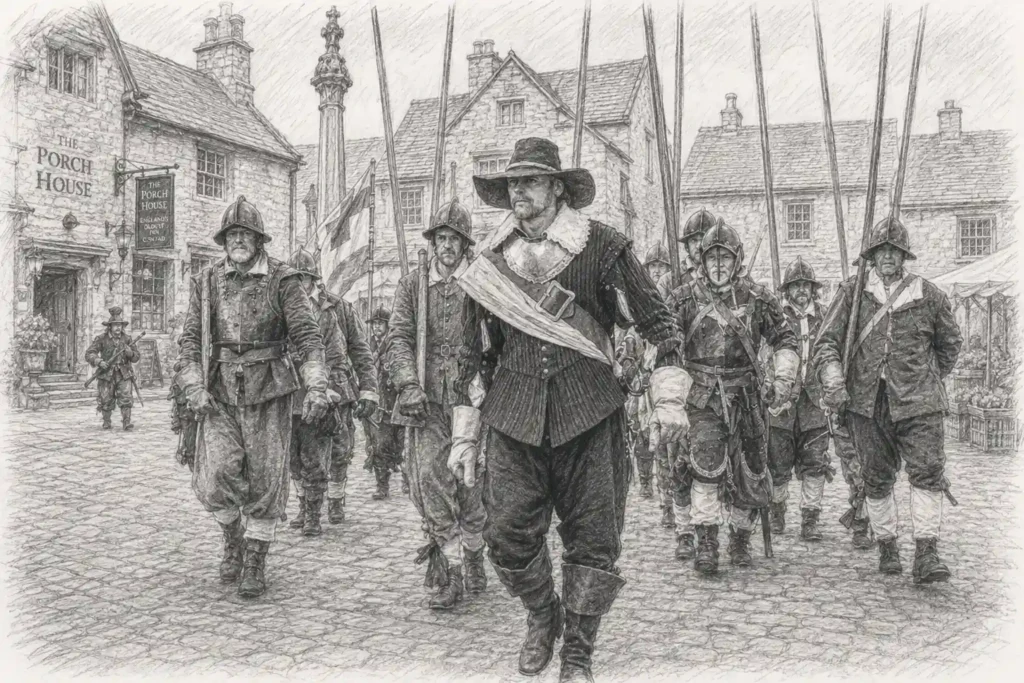
On 21 March 1646, the Battle of Stow-on-the-Wold was fought just outside the town. It is generally regarded as the last major pitched battle of the First English Civil War.
The Royalist army under Sir Jacob Astley was attempting to reach King Charles I at Oxford when it was intercepted north of Stow by Parliamentarian forces.
The Royalists were defeated and pursued back towards the town, with fighting reaching Stow itself. Historic England records that the defeated Royalist infantry were chased as far as the Market Square.
Prisoners were subsequently held in St Edward’s Church (also notable as an inspiration for Tolkien).
Suddenly another attractive Cotswolds church becomes something quite different: a building connected directly with one of the defining conflicts in British history.
And once again, unless somebody tells you, much of that history is invisible.
The stories hidden in plain sight
This is one of the great pleasures of travelling through the Cotswolds with a local guide.
The places themselves are beautiful, but beneath the surface there are layers everywhere.
A pub might tell the story of medieval travel.
An oversized market square can reveal the extraordinary importance of the wool trade.
A narrow alleyway can show how thousands of sheep were moved through a town.
A church can lead into the English Civil War.
An old road might have been carrying travellers across this landscape for nearly two thousand years.
And an architectural detail that most visitors would pass without noticing may reveal when a building was altered, who paid for it or what the village was doing when it was constructed.
John’s role is therefore not simply to take you to the Cotswolds.
It is to help you read the Cotswolds.

A private tour can follow the story, rather than a timetable
There is another advantage to travelling privately.
History rarely fits neatly into a fixed coach-tour itinerary.
If something particularly interests you, John can spend longer discussing it. If you are fascinated by architecture, churches, the wool trade, the Civil War or traditional Cotswolds villages, the day can naturally develop around those interests.
And because the tour is private, there is time for conversation.
That may involve discussing why one village developed while another did not, why a particular road follows its strange route, what happened to the great Cotswolds wool fortunes or how the landscape has changed over centuries.
These conversations are often what visitors remember most.
Stow-on-the-Wold is an excellent place to begin – or finish
Stow works particularly well as a starting or finishing point for a private Cotswolds tour.
Visitors staying in Stow can be collected directly from their hotel or accommodation, allowing the tour to begin immediately among some of the historic buildings and streets described above.
For visitors travelling from London by train, the particularly convenient railhead is nearby Moreton-in-Marsh, rather than Stow itself.
Great Western Railway serves the Cotswolds through Moreton-in-Marsh, and direct trains operate between London Paddington and Moreton-in-Marsh, with the fastest journeys taking around an hour and a half. (The Trainline)
John can therefore arrange collection at Moreton-in-Marsh station and, within a short drive, you can be exploring Stow and the surrounding North Cotswolds.
It makes a private guided tour entirely practical as part of a Cotswolds break – or even as a carefully planned day out from London.
Don’t just visit the Cotswolds. Discover it.
There is nothing wrong with coming to the Cotswolds for the views. They are every bit as beautiful as the photographs suggest.
But the landscape becomes much richer when someone can explain why it looks the way it does and what happened here.
The Porch House is a perfect example.
You can photograph a sign claiming that an inn dates back to AD 947.
Or you can stand outside it with a local guide and begin a conversation that takes you from Saxon England to medieval markets, the wool trade, ancient roads, Jacobean architecture and the English Civil War.
That is the real value of a curated Cotswolds tour.
You don’t simply see more. You understand more.
If you would like to discover the historic villages, hidden details and stories of the Cotswolds with a knowledgeable local guide, contact Cotswolds Travel to discuss a private tour with John tailored around the places and periods that interest you most.
