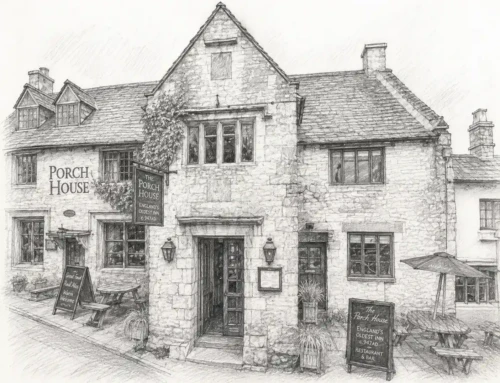
The Cotswolds is a landscape that feels almost timeless. With its rolling hills, historic market towns and centuries-old inns, it is often associated with classic English storytelling. Among the writers whose work feels closely aligned with this region is J.R.R. Tolkien, author of The Hobbit and The Lord of the Rings.
While Tolkien never mapped Middle-earth directly onto the Cotswolds, several locations in Gloucestershire and the northern Cotswolds have long been linked to his travels and to places described in his books. Exploring these sites offers a unique way to experience the region — blending literary history with some of the most beautiful scenery in England.
The Bell Inn, Moreton-in-Marsh and the Prancing Pony
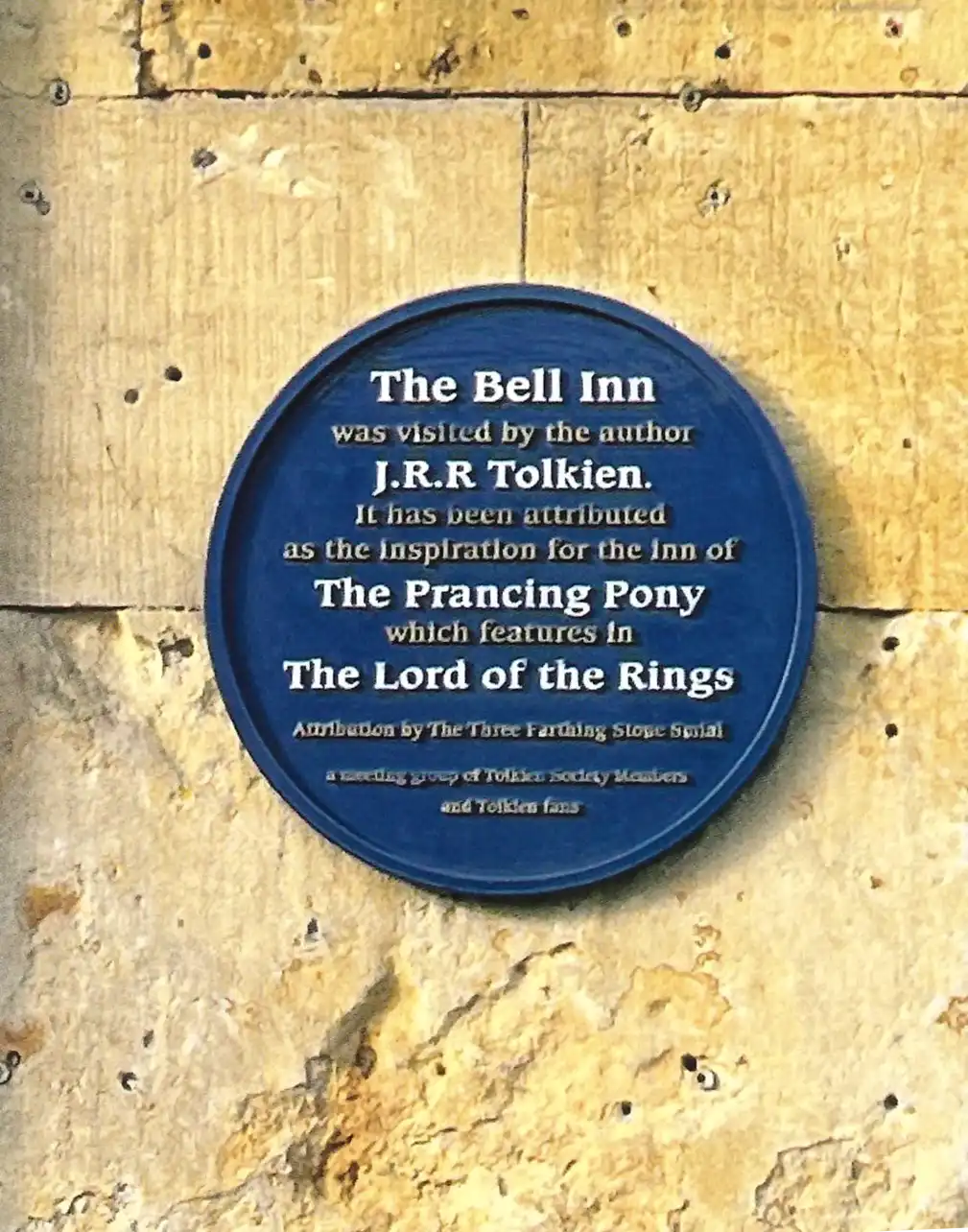
One of the strongest Tolkien connections in the Cotswolds can be found in Moreton-in-Marsh, at The Bell Inn. A blue plaque mounted on the inn’s exterior states that J.R.R. Tolkien visited the Bell Inn, and that it has been attributed as an inspiration for The Prancing Pony, the famous inn in The Lord of the Rings.
The Prancing Pony, located in the town of Bree, is a pivotal setting in the story — a meeting place for travellers, a refuge for weary companions and a crossroads of information and intrigue. The Bell Inn, a historic coaching inn on an ancient route through the Cotswolds, closely mirrors this role.
While Tolkien never formally confirmed the link, the attribution — credited by Tolkien scholars and enthusiasts — is entirely plausible. Tolkien frequently stayed in traditional English inns, and he drew inspiration from places that felt lived-in, welcoming and rooted in history.
The Cotswolds Landscape and Tolkien’s Vision of the Shire
Tolkien often spoke of his affection for the English countryside, particularly landscapes that had avoided industrialisation. While his childhood in Sarehole near Birmingham is widely acknowledged as a key influence on the Shire, the wider Cotswolds shares many of the same defining characteristics.
Dry stone walls, patchwork fields, gentle valleys and villages built from local stone all reflect the pastoral world Tolkien created for the hobbits. Travelling through the Cotswolds today, it is easy to see how this landscape could reinforce — or even refresh — the mental images behind Middle-earth.
Rather than copying real locations directly, Tolkien absorbed atmosphere, scale and rhythm — qualities the Cotswolds delivers in abundance.
Read more about Moreton-in-Marsh here.
Stow-on-the-Wold: Ancient Crossroads and Gathering Places
A short journey from Moreton-in-Marsh brings you to Stow-on-the-Wold, one of the highest towns in the Cotswolds and historically one of its most important. For centuries, Stow sat at the junction of major routes and hosted large sheep fairs, drawing people from across the region.
This idea of a crossroads town resonates strongly with Tolkien’s storytelling. In The Lord of the Rings, inns, towns and meeting places are rarely accidental; they are points where paths cross and stories converge.
Although there is no direct evidence linking Tolkien to Stow-on-the-Wold specifically, its history and setting make it a natural inclusion on any Tolkien-inspired Cotswolds itinerary.
Internal link suggestion:
→ Explore Stow-on-the-Wold and the northern Cotswolds
Oxford, the Northern Cotswolds and Tolkien’s Travels
As a long-standing professor at Oxford University, Tolkien had easy access to the northern Cotswolds, whether by train or road. Villages such as Bourton-on-the-Water, Lower Slaughter and Upper Slaughter are often noted by readers for their visual similarity to the Shire.
Clear streams, low bridges, village greens and unhurried lanes reflect the quiet rural ideal that runs throughout Tolkien’s writing. While these links remain speculative, they speak to how closely the Cotswolds aligns with Tolkien’s literary imagination.
Inns, Roads and the Importance of the Journey
In Tolkien’s world, the road is never just a route — it is a place of transformation. Inns and stopping points play a vital role in his stories, offering warmth, danger, conversation and revelation in equal measure.
The Cotswolds, with its network of ancient roads and historic inns, mirrors this storytelling structure perfectly. Travelling through the region at a slower pace allows visitors to experience the same sense of progression and discovery that defines Tolkien’s work.
Follow Tolkien’s Footsteps with Cotswolds Travel
Exploring the Cotswolds through the lens of J.R.R. Tolkien adds an extra layer of depth to an already remarkable destination. From the Bell Inn in Moreton-in-Marsh to timeless market towns and gently rolling countryside, the region invites visitors to slow down and let the landscape tell its story.
Cotswolds Travel offers bespoke private tours, transfers and itineraries designed to help you experience the Cotswolds at its best — whether you’re a Tolkien enthusiast, a literature lover or simply drawn to England’s most evocative countryside.
Let us take you beyond the guidebooks and into a Cotswolds that feels straight out of Middle-earth.