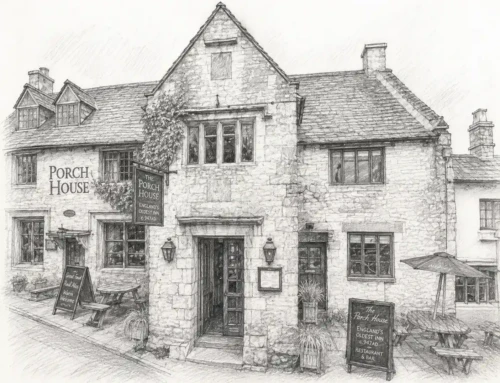
The Cotswolds has long inspired writers, artists and storytellers, and few imagined worlds feel as closely aligned with its landscapes as Alice’s Adventures in Wonderland. Rather than being rooted in a single location, Lewis Carroll’s Wonderland seems to emerge from atmosphere – from gardens, water, winding paths and places that invite curiosity.
For visitors exploring the region, these connections offer a richer way of seeing the Cotswolds. Many of the places you pass through on a day out or longer stay echo the ideas, characters and moments found in Carroll’s writing. It is little surprise that many of John Batchelor’s guided journeys with Cotswolds Travel naturally touch on these themes, weaving literary anecdotes into wider stories about the countryside, villages and people of the area.
Cowley Manor: Where Wonderland Feels Close to the Surface
Set among springs, water features and secluded gardens, Cowley Manor feels like a place where imagination is gently encouraged. In 1865 – the year Alice’s Adventures in Wonderland was first published – the estate already possessed the kind of romantic landscaping that feels instantly familiar to readers of Carroll’s work.
Seven natural springs pass through the grounds, shaping the landscape in subtle but evocative ways. The most striking lies just below the rear of the manor, flowing down a water staircase before settling into a lower pool now home to two elegant white swans. These quiet, reflective spaces recall the pools, rivers and threshold moments that recur throughout Wonderland.
Today, the hotel acknowledges these literary associations in playful detail. The White Rabbit appears on golden door knockers, checkerboard patterns from Through the Looking-Glass are echoed in rugs, and a whimsical nod appears at turndown with a single macaron beneath a glass cloche marked “Eat Me.” These touches do not claim certainty, but invite guests to make their own connections between story and place.
Naunton: A Carrollian Village in the Heart of the Cotswolds
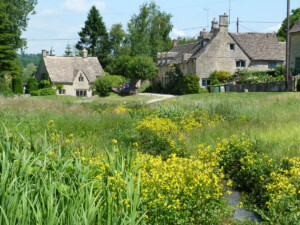
Beyond Cowley Manor, the wider Cotswolds offers places whose atmosphere feels naturally aligned with Lewis Carroll’s imagination. Naunton is one such village. Shaped by the gentle course of the River Windrush, with stone bridges, curving lanes and a sense of quiet enclosure, it possesses many of the qualities readers instinctively associate with Wonderland.
Charles Lutwidge Dodgson – known as Lewis Carroll – travelled widely, and local tradition has long linked him to this part of the Cotswolds. What matters most here, however, is not the certainty of influence but the suitability of the setting itself. Naunton’s scale, softness and intimacy reflect the kind of landscapes that recur throughout Alice’s Adventures in Wonderland: places that feel self-contained, slightly removed from the outside world, and rich in possibility.
Over the years, stories have circulated around figures bearing the name Alice in and around the village, adding an additional layer of intrigue. Rather than pointing to a single source of inspiration, these coincidences reinforce a broader truth – that Carroll’s work emerged from a cultural and physical landscape filled with riverside walks, village life and imaginative storytelling.
Standing beside the water or crossing one of Naunton’s stone bridges, it is easy to see why such places are often described as Carrollian. The village does not claim to be Wonderland, but it captures something essential to it: a feeling that stories might begin, quite naturally, just here.
The Cotswolds as a Landscape of Curiosity
What links Cowley Manor, Naunton and many other corners of the Cotswolds is not factual certainty, but shared character. Wonderland is defined by movement, surprise and shifts in perspective: paths that lead somewhere unexpected, gardens that seem to change scale, water that draws the eye onward.
The Cotswolds landscape reflects this sensibility. Valleys fold gently into one another, springs emerge without warning, and villages reveal themselves slowly. For those travelling through the region, these qualities reward curiosity and unstructured exploration – whether on foot, by car, or simply by lingering longer than planned.
Stories You Encounter Along the Way
 Part of the pleasure of exploring the Cotswolds lies in the stories that surface almost incidentally. Literary references, local anecdotes and historical details often emerge naturally when visiting places with long, layered pasts. On many journeys through the region, tales of Lewis Carroll and Alice in Wonderland appear not as a central theme, but as part of a broader narrative about creativity, landscape and English life.
This is why Wonderland resonates so strongly here. It feels less like a destination to be pinned down, and more like a way of seeing – one that values imagination alongside observation.
Seeing the Cotswolds Through a Literary Lens
Approaching the Cotswolds with literature in mind encourages a slower, more attentive form of travel. Gardens become stages, rivers become thresholds, and villages carry echoes of the stories once told within them.
Whether you are staying at Cowley Manor, passing through villages like Naunton, or simply exploring the countryside at your own pace, the world behind Alice’s Adventures in Wonderland is never far away. These are places that reward curiosity and invite interpretation – much like Carroll’s writing itself.
In the Cotswolds, the most memorable discoveries are often the ones you were not actively seeking. Sometimes, all it takes is a story, a landscape, and the willingness to follow where they lead.